
Video Production Styles Explained: Which Style Is Right for Your Business?
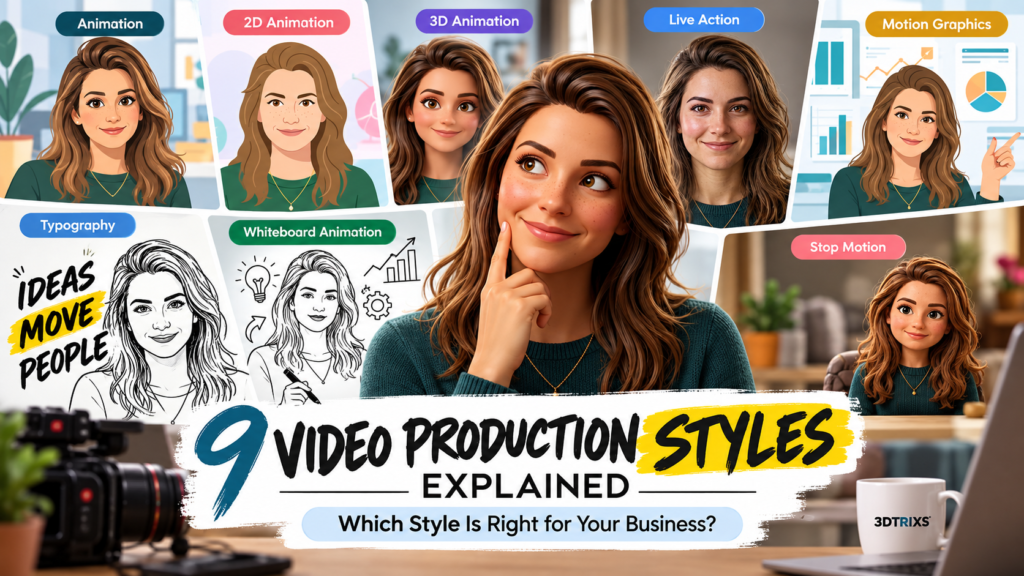
Choosing a video style sounds simple until you actually have to choose one. Should your business use live action? Would 2D animation explain the idea better? Does the product need 3D? Would motion graphics be enough?
There is no universal winner. The right video production style depends on what you are trying to communicate, who needs to understand it, and where the video will be used.
A manufacturing company showing the inside of a machine has very different needs from a hotel promoting its property. A SaaS company explaining software has a different challenge again.
Here’s a practical look at nine video production styles, what each one does well, where it falls short, and which businesses should consider using it.
What Are the Main Video Production Styles?
The nine styles covered in this guide are AI videos, animation, 2D animation, 3D animation, live action, motion graphics, typography, whiteboard animation, and stop motion animation.
Some overlap. Animation, for example, is a broad category that includes several styles on this list. That is worth understanding because choosing a style is less about putting a label on your video and more about finding the right visual language for the message.
Here’s the quick version before we get into each one.
| Video Style | Best For | Common Uses |
|---|---|---|
| AI Videos | Creative experimentation | Ads, social content, conceptual videos |
| Animation | Visual storytelling | Explainers, education, brand stories |
| 2D Animation | Simple explanations | Explainers, training, SaaS |
| 3D Animation | Products and technical subjects | Product demos, engineering, medical |
| Live Action | People and real environments | Corporate films, ads, testimonials |
| Motion Graphics | Information and data | SaaS, corporate, finance |
| Typography | Strong written messages | Ads, social videos, announcements |
| Whiteboard Animation | Step-by-step explanation | Education, training, explainers |
| Stop Motion | Distinctive product content | FMCG, retail, social campaigns |
1. AI Videos
What Are AI Videos?
AI videos use generative tools during some or most of the production process. Depending on the project, that could include generating scenes, environments, characters, images, voices, animations, or visual variations.
The interesting part is not simply that AI can generate video. It gives creative teams another way to explore ideas that may be difficult to produce through conventional filming or animation.
A brand could create a surreal product environment, experiment with several visual directions, or build short campaign content without physically producing every element on screen.
Who Should Use AI Videos?
AI video makes the most sense when creative flexibility matters more than strict physical realism. Advertising, ecommerce, technology, fashion, lifestyle, and digital-first brands are obvious candidates.
It can also work well for social campaigns where unusual imagery helps stop the scroll. For highly technical products, however, generated visuals may need much more supervision because small inaccuracies matter.
Benefits and Drawbacks of AI Videos
| Benefits | Drawbacks |
|---|---|
| Wide creative possibilities | Visual consistency can be difficult |
| Useful for conceptual visuals | Precise product accuracy needs supervision |
| Fast experimentation | Results can sometimes feel generic |
| Can complement traditional production | Not ideal for every brand or message |
The key is to treat AI as a production option rather than the idea itself. A weak concept does not suddenly become a strong campaign because AI was used to make it.
2. Animation
What Is Animation?
Animation is the broadest category on this list. Instead of recording everything with a camera, artists create movement using illustrations, graphics, characters, objects, or digital environments.
That freedom makes animation useful when reality gets in the way of the explanation. A process can be simplified, an abstract concept can be given a visual form, and a story can take place in an environment that does not physically exist.
2D, 3D, whiteboard, and stop motion can all fall under the wider animation umbrella, but each has its own strengths.
Who Should Use Animation?
Animation works particularly well for education, healthcare, technology, SaaS, finance, HR, training, and corporate communication.
It is also useful when a business wants to build a distinct visual identity rather than rely on stock footage or conventional corporate filming.
Benefits and Drawbacks of Animation
| Benefits | Drawbacks |
|---|---|
| High creative freedom | Good animation takes planning |
| Makes abstract ideas visible | Complex animation can take time |
| Easy to build around brand identity | Less suitable when real people are important |
| No physical location restrictions | Quality depends heavily on design and execution |
Animation is a good choice when the idea is easier to create than to film.
3. 2D Animation
What Is 2D Animation?
2D animation uses flat illustrations, characters, objects, and environments to tell a story or explain an idea. It does not try to recreate the physical depth of the real world in the way 3D animation does.
That simplicity is often exactly why it works. Instead of showing every detail, 2D animation can strip a complicated subject down to the few things the viewer actually needs to understand.
Characters can demonstrate a customer problem. Illustrations can show a process. A software service can be turned into a simple visual journey.
Which Industries Are Best for 2D Animation?
SaaS, healthcare, education, fintech, insurance, HR, startups, and professional services are strong fits.
It is especially useful for explainer videos because businesses can build the entire visual language around the script instead of searching for footage that roughly represents what is being discussed.
Benefits and Drawbacks of 2D Animation
| Benefits | Drawbacks |
|---|---|
| Excellent for explainers | Limited realism |
| Strong storytelling potential | Not ideal for detailed physical products |
| Flexible visual style | Character animation can add complexity |
| Easy to simplify difficult ideas | Does not show depth as naturally as 3D |
Choose 2D when understanding the story matters more than showing something realistically.
4. 3D Animation
What Is 3D Animation?
3D animation creates digital objects and environments with depth. Products can be rotated, opened, dismantled, enlarged, cut away, or viewed internally without being limited by what a physical camera can capture.
This is where 3D becomes especially useful for product and technical communication. Imagine trying to film airflow inside an appliance, components operating inside a machine, or the layers hidden inside a product. A camera may not be able to see them. 3D can.
It can also be highly realistic. Materials, lighting, reflections, movement, and camera angles can be controlled to create everything from an engineering demonstration to a cinematic product film.
Which Industries Are Best for 3D Animation?
3D animation is particularly useful for manufacturing, automotive, aerospace, engineering, healthcare, biotechnology, architecture, electronics, and consumer products.
Companies with complicated machinery or products with important internal features can get a lot from it.
Benefits and Drawbacks of 3D Animation
| Benefits | Drawbacks |
|---|---|
| Shows products from any angle | Detailed production takes time |
| Can reveal internal components | Accurate reference material is important |
| Strong for technical explanation | Complex scenes require more production work |
| Can achieve realistic product visuals | Rendering and simulation can add complexity |
If the most valuable part of your product cannot be filmed, 3D animation is often worth considering.
5. Live Action
What Is Live Action Video?
Live action uses real people, products, locations, and environments. It is what most people think of when they hear traditional video production.
Its biggest strength is simple: reality is difficult to fake convincingly when people are the point of the story. If you want customers to meet your team, see your factory, experience your hotel, or hear from an actual client, live action makes sense.
It can be as simple as a well-shot interview or as elaborate as a commercial involving actors, sets, specialised cameras, and multiple locations.
Which Industries Are Best for Live Action?
Corporate businesses, hospitality, healthcare, manufacturing, automotive, education, real estate, and consumer brands all use live action heavily.
It works particularly well for corporate films, testimonials, facility videos, recruitment films, advertisements, and brand stories.
Benefits and Drawbacks of Live Action
| Benefits | Drawbacks |
|---|---|
| Feels authentic | Requires physical production |
| Strong human connection | Locations and schedules need coordination |
| Shows real products and facilities | Major changes may require reshooting |
| Excellent for testimonials | Some ideas are difficult to film |
If the people, place, or real-world experience are part of what you are selling, live action is usually difficult to beat.
6. Motion Graphics
What Are Motion Graphics?
Motion graphics use moving design elements such as icons, shapes, charts, text, illustrations, and interface elements to communicate information.
The difference between motion graphics and 2D animation can sometimes get blurry. A useful way to think about it is that 2D animation often focuses more on characters and storytelling, while motion graphics usually focuses more on information, design, and movement.
A chart can animate instead of sitting on screen. A workflow can build itself step by step. Software features can be highlighted without turning the entire video into a character-driven story.
Which Industries Are Best for Motion Graphics?
Technology, SaaS, finance, consulting, telecommunications, education, and corporate businesses use motion graphics frequently.
It is particularly effective for data, software, processes, presentations, corporate explainers, and subjects that are difficult to film because they do not physically exist.
Benefits and Drawbacks of Motion Graphics
| Benefits | Drawbacks |
|---|---|
| Makes information easier to follow | Less human than live action |
| Great for data and software | Not ideal for realistic products |
| Works well with brand design | Can feel dry without strong direction |
| Combines easily with live action | Complex storytelling may need another style |
Motion graphics works best when the challenge is not showing an object, but making information easier to understand.
7. Typography Videos
What Is a Typography Video?
Typography videos make words part of the visual experience. Text does not simply appear at the bottom of the screen. It moves, changes size, reacts to rhythm, and directs attention.
This works particularly well when the message itself is strong. A statistic, statement, headline, or short piece of copy can become the centre of the scene without needing complicated imagery around it.
Typography can also be mixed with footage, motion graphics, or animation rather than carrying the entire video alone.
Which Industries Are Best for Typography Videos?
Advertising, events, entertainment, technology, corporate communication, and social media campaigns can all use typography effectively.
It is particularly useful for short-form videos where viewers need to understand the message quickly, including situations where the video may initially be watched without sound.
Benefits and Drawbacks of Typography Videos
| Benefits | Drawbacks |
|---|---|
| Communicates quickly | Relies heavily on good copy |
| Strong for short-form content | Too much text becomes tiring |
| Works without audio | Limited for detailed visual demonstrations |
| Can create strong visual rhythm | Poor typography can hurt readability |
Typography works when the words deserve to be the visual.
8. Whiteboard Animation
What Is Whiteboard Animation?
Whiteboard animation builds an explanation through drawings that appear progressively while the story or narration moves forward.
The format is deliberately simple. The viewer watches the idea develop rather than being presented with a complicated finished scene all at once. That can make difficult subjects easier to follow.
It may not have the visual richness of 3D animation or live action, but that is not really the point. Whiteboard animation is usually about clarity.
Which Industries Are Best for Whiteboard Animation?
Education, training, finance, insurance, healthcare, HR, and professional services are good fits.
It works particularly well for processes, educational subjects, internal communication, and explanations where the viewer needs to follow a sequence of ideas.
Benefits and Drawbacks of Whiteboard Animation
| Benefits | Drawbacks |
|---|---|
| Easy to follow | Limited visual richness |
| Good for complex explanations | Not ideal for premium product presentation |
| Keeps focus on the message | Can feel repetitive in longer videos |
| Strong educational format | Limited realism |
Whiteboard animation makes sense when you would rather have the viewer understand the idea than be impressed by the production.
9. Stop Motion Animation
What Is Stop Motion Animation?
Stop motion creates movement by photographing physical objects one frame at a time, changing their position slightly between each image. When those frames are played together, the objects appear to move on their own.
It has a physical quality that is hard to reproduce with conventional digital animation. Packaging can assemble itself, ingredients can move across a table, products can interact with everyday objects, and simple scenes can become surprisingly playful.
That handmade character is exactly what gives stop motion its appeal.
Which Industries Are Best for Stop Motion?
FMCG, food, retail, fashion, beauty, toys, lifestyle, and consumer brands are particularly good fits.
Products with distinctive packaging, shapes, colours, or ingredients tend to give creative teams plenty to work with.
Benefits and Drawbacks of Stop Motion
| Benefits | Drawbacks |
|---|---|
| Visually distinctive | Frame-by-frame production takes time |
| Gives products a tactile quality | Continuity requires careful control |
| Great for short-form advertising | Changes can be difficult after shooting |
| Strong social media potential | Not suited to every subject |
Stop motion is worth considering when standing out is part of the brief, especially for physical consumer products.
How Do All 9 Video Production Styles Compare?
Now that we have looked at each style individually, the differences become easier to see.
| Style | Best Use | Strongest Quality | Main Limitation |
|---|---|---|---|
| AI Videos | Creative campaigns | Experimentation | Consistency |
| Animation | Visual storytelling | Creative freedom | Production varies widely |
| 2D Animation | Explainers | Simplicity | Limited realism |
| 3D Animation | Products and technical content | Depth and visualisation | Production complexity |
| Live Action | People and real environments | Authenticity | Physical limitations |
| Motion Graphics | Information and data | Clarity | Less human |
| Typography | Message-led content | Speed of communication | Depends on strong copy |
| Whiteboard | Education | Easy explanation | Limited visual richness |
| Stop Motion | Creative product content | Distinctiveness | Time-intensive production |
Here’s the thing: this table should not be used to pick a winner. It should help you eliminate the styles that do not fit the job.
If customers need to see your actual facility, choose live action. If they need to see inside your product, consider 3D. If they need to understand a software workflow, motion graphics or 2D may be better.
Which Video Style Is Best for Different Industries?
Industry matters, but the purpose of the video matters more. A manufacturing company may use 3D animation for a machine demonstration and live action for its corporate film. The same company could use motion graphics for an investor presentation.
| Industry | Video Styles Worth Considering |
|---|---|
| Manufacturing | 3D Animation, Live Action, Motion Graphics |
| SaaS & Technology | 2D Animation, Motion Graphics, AI Videos |
| Healthcare | 2D Animation, 3D Animation, Live Action |
| Automotive | Live Action, 3D Animation, Motion Graphics |
| Education | 2D Animation, Whiteboard, Motion Graphics |
| FMCG | Live Action, Stop Motion, 3D Animation |
| Ecommerce | AI Videos, 3D Animation, Live Action, Stop Motion |
| Corporate & BFSI | Live Action, Motion Graphics, Typography |
| Architecture & Real Estate | 3D Animation, Live Action |
| HR & Training | 2D Animation, Live Action, Whiteboard |
What this really means is that your industry gives you a starting point, not an answer.
Can You Combine Different Video Styles?
Absolutely. In many cases, combining styles produces a better video than forcing everything into one format.
A corporate film might use live action for interviews and motion graphics for statistics. A product video might begin with live action and switch to 3D when the camera needs to reveal what is happening inside the product.
You can also combine 2D animation with typography, 3D with motion graphics, or AI-generated scenes with traditionally produced footage. The combination should solve a communication problem, not simply add more visual effects.
The viewer should feel like they are watching one video, not five production techniques fighting for attention.
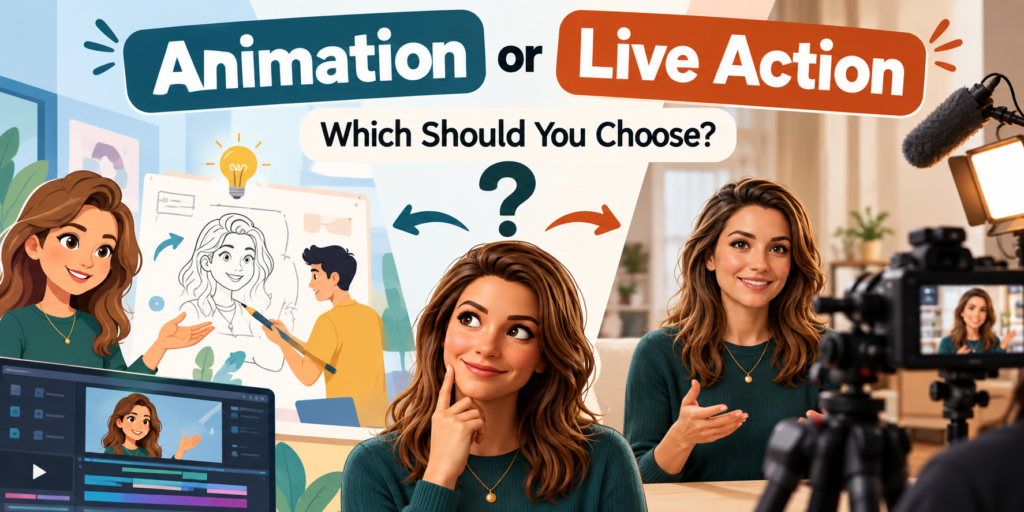
Animation or Live Action: Which Should You Choose?
Choose live action when real people, places, products, or experiences are central to the story. Choose animation when the subject is abstract, difficult to film, technically complicated, or better explained visually.
For example, a hospital may use live action to introduce its doctors and facilities but use 3D animation to explain a medical procedure. A software company may have little reason to film an office if its real challenge is explaining how its platform works.
Sometimes the answer is both. Live action can create trust while animation explains what the camera cannot show.
2D or 3D Animation: Which Is Better?
Neither is inherently better. They solve different problems.
2D animation is usually stronger when you need characters, storytelling, simplified concepts, or an illustrative visual language. 3D becomes more useful when depth, physical products, machinery, spatial relationships, materials, or internal components matter.
If you are explaining an insurance process, 2D may be enough. If you are showing how a gearbox works, 3D is likely to communicate much more.
The subject should make the decision.
Motion Graphics or 2D Animation?
This is one of the easiest distinctions to blur.
Motion graphics is usually design-led. Think charts, icons, interface elements, typography, shapes, and visualised information. 2D animation is more likely to use illustrated characters, environments, and narrative scenes.
A SaaS company explaining platform features may lean towards motion graphics. The same company telling a story about a customer struggling with a problem may find 2D character animation more useful.
There is also no reason the two cannot appear in the same video.
How Does Video Style Affect Production Cost?
The style matters, but complexity matters more.
A simple live action interview can cost less than a detailed 2D character animation. A straightforward 3D product rotation is very different from building a complete photorealistic environment with simulations and complex animation.
Duration also matters. So do the number of characters, locations, models, scenes, revisions, visual effects, rendering requirements, actors, crew, and level of finish.
Instead of asking which video style is cheapest, ask what level of production is actually necessary to communicate the idea well.
What Should You Decide Before Choosing a Video Style?
Start with the message.
What should someone understand after watching the video? What should they feel? What should they do next? Once those questions are clear, choosing the visual style becomes much easier.
You should also think about where the video will live. A 15-second social ad, a homepage explainer, a sales presentation, and a five-minute training video are different jobs. They should not automatically use the same production approach.
Finally, think about what absolutely needs to appear on screen. If real people matter, that points towards live action. If an invisible mechanism matters, 3D becomes interesting. If the information itself is the challenge, motion graphics may solve it.
3DTRIXS Insight
We often see businesses choose a video style because they like how another company’s video looks. That is understandable, but it can also send a project in the wrong direction.
A beautiful 3D animation is unnecessary if a straightforward live action film would tell the story better. In the same way, filming a complicated technical process simply because you want live action can make the explanation harder than it needs to be.
The style should follow the communication problem.
There is also no rule saying a project has to stay inside one category. Some of the strongest work comes from knowing when to switch techniques. Use live action where reality matters. Use animation where explanation matters. Use 3D where the camera reaches its limit.
Can 3DTRIXS Produce All These Video Styles?
Yes. 3DTRIXS works across AI videos, animation, 2D animation, 3D animation, live action, motion graphics, typography, whiteboard animation, and stop motion animation.
That range matters because the production method can be chosen around the project instead of fitting every brief into the same house style.
A corporate film might be primarily live action. A product demonstration may rely on 3D animation. A SaaS explainer could use motion graphics and 2D animation. A consumer campaign might combine live action, CGI, typography, or stop motion.
We can also build hybrid productions when one style is not enough. The goal is not to use every technique available. It is to use the ones that make the story clearer, the product easier to understand, and the final video worth watching.
If your business wants to explore AI without sacrificing creative direction or professional production quality, working with an experienced AI Video Production Company can help you turn new technology into content that delivers real marketing value.





Founded: 2014
Team Size: 40 to 50 Employees
Clients: Amazon, Paypal, Deloitte, Levis, Intel, EY and many more.
Pricing: $1,000+
Completed Projects: 8000+ | Clients: 800+ | Serving Countries: 15+

Conclusion
There are plenty of video production styles, but choosing between them does not need to be complicated.
Start with what you need to communicate. Then look at what the audience needs to see in order to understand or believe it.
If reality matters, live action is a strong choice. If you need to simplify a story, look at 2D animation. If you need to reveal a product or technical process, consider 3D. If information itself is the challenge, motion graphics may be the answer.
AI videos, typography, whiteboard animation, and stop motion open up other possibilities when the brief calls for them.
The best video style is not the one with the most impressive production technique. It is the one that makes the idea work.
Frequently Asked Questions
What are the most common video production styles?
Common video production styles include live action, 2D animation, 3D animation, motion graphics, whiteboard animation, typography, stop motion, AI videos, and broader animation formats. Different styles can also be combined within the same production.
Which video style is best for a business?
It depends on what the business needs to communicate. Live action is strong for people and real environments, 2D works well for simplified storytelling, 3D is useful for products and technical subjects, and motion graphics works well for information and data.
What is the difference between 2D and 3D animation?
2D animation works with flat illustrated elements, while 3D animation creates objects and environments with depth. 2D is often suited to explainers and character stories, while 3D is stronger for products, machinery, technical processes, and realistic visualisation.
Are motion graphics and 2D animation the same?
No. Motion graphics generally focuses on moving graphic elements such as icons, typography, charts, shapes, and interfaces. 2D animation often involves illustrated characters, environments, and more narrative-driven scenes.
Is animation better than live action?
Not necessarily. Animation offers more visual freedom, while live action gives you real people, places, and products. The better choice depends on the subject and what the audience needs to see.
Which video style works best for product videos?
It depends on the product. Live action is useful for showing a product in real use, while 3D animation can reveal internal components and technical features. Stop motion can work well for creative consumer campaigns, and AI videos can support more experimental visual concepts.
Can different video styles be used in the same video?
Yes. Live action can be combined with motion graphics, 2D animation, 3D animation, typography, VFX, or AI-generated elements. Mixing styles works best when each technique has a clear reason to be there.
Which video style is best for an explainer video?
2D animation and motion graphics are common choices for business explainers. Whiteboard animation works well for step-by-step educational content, while 3D animation is useful when the explainer involves a physical product, machinery, or a technical process.
Have a Project in Mind?
Tell us about your requirements, and our team will get in touch with you.
